TLC for Physics 1

In collaboration with Physics faculty, the Center for Academic Success (CfAS) offers a weekly workshop for students enrolled in Physics I (PHY 2048) called the TLC for Physics I (with Calculus). These sessions are led by trained tutors who have demonstrated success in Physics I. 

The workshop focuses on developing essential skills for success in physics, including algebraic manipulationanalyzing word problems to identify relevant information, and modeling physical situations. 

Topics covered include kinematics, forces, work and energy, conservation of momentum, rotational motion, torque, gravitation, and simple harmonic motion/mechanical waves. Sessions use PowerPoint presentations with interactive activities and practice problems. Each week covers a different presentation; see the workshop syllabus below for details. 

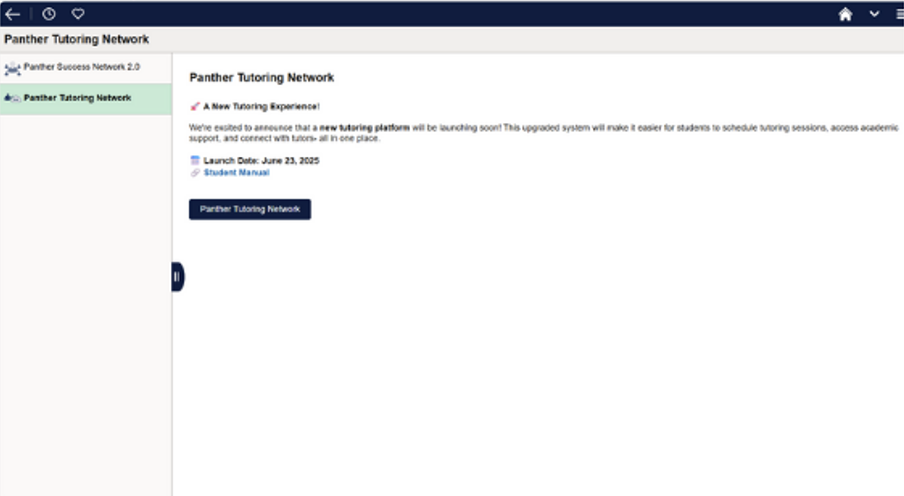
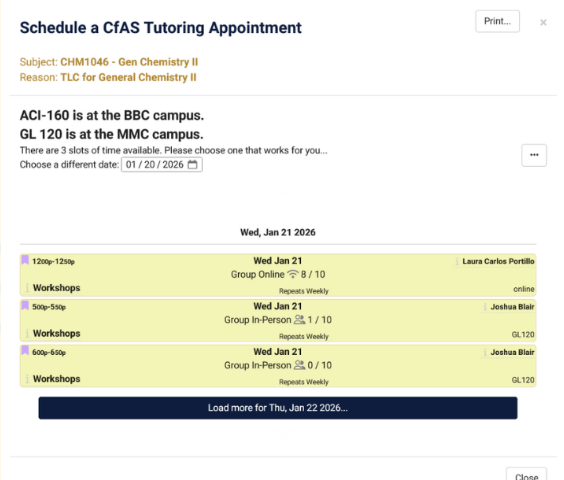
Students may attend by reserving a spot through the Panther Tutoring Network (PTN). 

For questions about the Physics I TLC sessions, please contact CfAS Math and Physics Coordinator Jared Banks at jarbanks@fiu.edu or 305-348-0360. 

Monday, January 20th - Friday, April 16th
Note: Weekends are only offered remotely via Zoom.
DAYSTIMESTUTORROOMZOOM
Monday11 a.m.-12 p.m.Sean

MMC GL120

Tuesday12 p.m.-1 p.m.Jared

MMC GL120


Wednesday4 p.m.-5 p.m.Carlos

MMC GL120


Thursday1 p.m.-2 p.m.Jared

MMC GL120


  • Workshop Expectations


    1. Be prepared. Bring your textbook, syllabus, and any pertinent materials related to your class. Any forms of assessment are extremely helpful.
    2. Be on time. Sessions are one hour in length. The tutors need all of this time in order to provide each participant with the necessary attention and detail to his/her progress.
    3. Be consistentYou are welcome to attend as many sessions as you like. It is to your benefit to attend on a weekly basis to reinforce your understanding. Plus, your professors might be more inclined to offer more points for your attendance.
    4. Be receptive.You will learn a variety of study strategies throughout these sessions. Depending on your background in physics, some strategies may be more helpful than others. Keep them all in your "metacognitive bank" as different problems may require different thought processes.
    5. Be responsible.Once your register for a workshop at CfAS you are reserving a place that no other student can take. Be considerate with these workshops.Keep your Panther ID handy when you check in with the front desk. You must enter your information at the front area of our center, and make sure that your tutor records your attendance.
  • Workshop Syllabus

    Workshop Syllabus:

    · Week 1: Vector Analysis

    This session covers the fundamental concept in which Physics revolves around - vectors. Electronic devices are not required but encouraged! You must participate in the problem-solving sections to earn credit.

    · Week 2: Kinematics 1D Motion

    This session investigates 1D motion, including velocity, acceleration and position. Electronic devices are not required but encouraged! You must participate in the problem-solving sections to earn credit.

    · Week 3: Kinematics 2D Motion

    This session covers 2D motion, the most common being projectile motion as well as how to navigate components in motion. The session also goes over key terms to look out for in kinematics problems. Electronic devices are not required but encouraged! You must participate in the problem-solving sections to earn credit.

    · Week 4: Intro to Newton's Laws

    This session covers the essentials of Newton's 3 Laws as well as instruction on the free-body diagram. Electronic devices required! You must participate in the problem-solving sections to earn credit.

    · Week 5: Working with Forces

    This session covers one of the most important physics equations of all time, Newton's second law. Investigate how forces interact with each other and how to use the free-body diagram to it's fullest potential. Electronic devices are not required but encouraged! You must participate in the problem-solving sections to earn credit.

    · Week 6: Kinetic Energy and Work

    This session introduces a fundamental aspect of the universe, energy and work. Take a closer look at what motion entails in this session and how it can be related to work. Electronic devices are not required but encouraged! You must participate in the problem-solving sections to earn credit.

    · Week 7: Energy Conservation, Potential Energy

    This session covers another fundamental aspect of the universe, the different types of potential energy and energy conservation. Work through problems involving friction and learn how to fully use the work-energy theorem. Electronic devices are not required but encouraged! You must participate in the problem-solving sections to earn credit.

    · Week 8: Momentum

    This session covers the extraordinary physics behind collisions. Learn when momentum and kinetic energy are conserved and how to navigate the different kinds of collisions. Electronic devices are not required but encouraged! You must participate in the problem-solving sections to earn credit.

    · Week 9: Circular Motion

    This session introduces the concept of circular motion, involving moment of inertia, circular kinematics and kinetic energy within rotations. Electronic devices are not required but encouraged! You must participate in the problem-solving sections to earn credit.

    · Week 10: Torque

    Investigate the properties of rotation and how force relates to it with torque. Learn how to incorporate work and forces within rotating bodies in this session. Electronic devices are not required but encouraged!

    · Week 11: Gravitation

    This session covers the essentials of Kepler's Laws as well as the laws of gravitation that every solar system, including our own, abides by. Electronic devices are not required but encouraged! You must participate in the problem-solving sections to earn credit.

    · Week 12: Simple Harmonic Motion

    This session covers the special properties that arise from springs, pendulums and so on. Practice through problems involving the different scenarios in which harmonic motion arise from. Electronic devices are not required but encouraged! You must participate in the problem-solving sections to earn credit.

    · Week 13: Waves

    This session covers the physics behind waves. Learn about the wave equation, the calculus behind waves as well as standing waves. Electronic devices are not required but encouraged! You must participate in the problem-solving sections to earn credit.

    · Week 14: Review for Final

    This session is a review for your final exam. Ace your exam with CfAS!

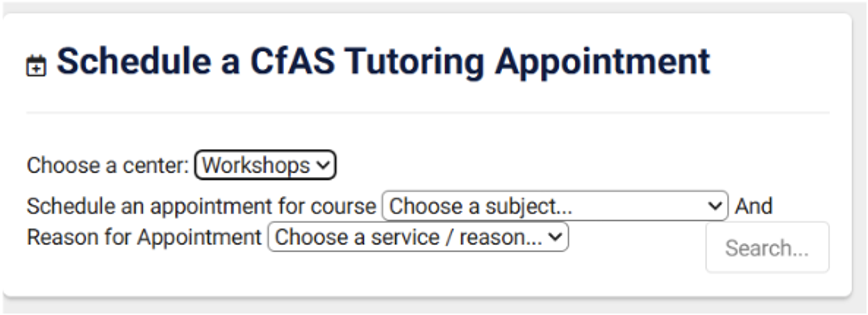
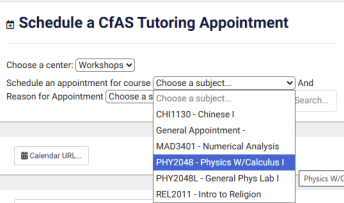
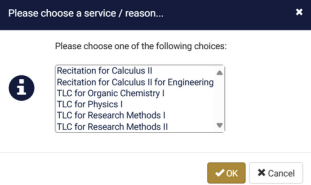
On the PTN dashboard, navigate to the scheduling widget, select 'Workshops' for Center, and fill out the appropriate Subject and Reason. Then Search and select an available time that interests you. 

about.jpg

about.jpg